Channel Letter Mounting Mistakes: Why Perfect Signs Fail On-Site (Pre-Order Checklist)
Posted by Mengban Team on Sep 22nd 2026
Many sign shops and overseas contractors face an identical, devastating project scenario:
Your custom channel letters arrive via shipping container. Unboxing inspection goes perfectly. The paint finish is flawless, LED lights turn on evenly, dimensions match the design proof, and there are zero factory defects.
But when your installation team arrives on-site and tries to mount them—nothing lines up.
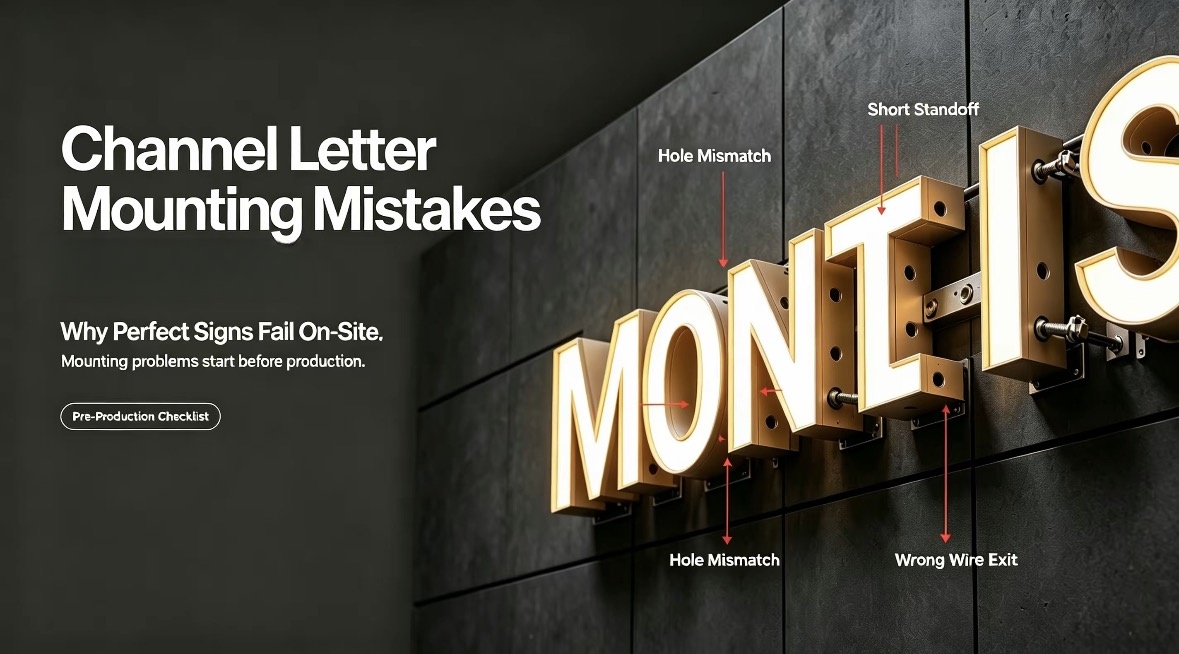
The first letter’s mounting holes do not match the on-wall bracket layout. The second letter’s standoff screws are far too short for the wall thickness. The third letter has a wire exit on the right side, while your on-site power source is positioned on the left.
The sign itself is perfect. Yet the entire project stalls. Installation halts, last-minute modifications cost extra labor fees, deadlines slip, and clients grow frustrated.
This frustrating issue is not caused by poor manufacturing quality. It stems from pre-production blind spots. Most mounting failures happen long before the shipment leaves the factory.
Nearly all public sign content teaches installers how to mount signs on site. Very few guide international buyers on what to confirm before production, to avoid on-wall failures entirely.
This guide breaks down the five hidden pre-order mounting pitfalls that derail overseas sign projects, clarifies the responsibility boundary between factories and local installers, and shares a complete actionable checklist to guarantee smooth installation.
1. Unconfirmed Wall Substrate (The Root Cause of Most Failures)
Most factory mounting configurations are based on a standard solid concrete wall by default.
Factories pre-set standard standoff lengths, standard fixing screws, and universal mounting hole layouts. However, commercial project walls vary drastically: drywall, hollow brick, marble, glass curtain walls, aluminum panel facades, and heritage building surfaces all require completely different mounting solutions.
When buyers do not confirm wall substrate upfront:
- Standard screws become too short or cannot grip hollow walls
- Ordinary fixing hardware fails on smooth stone or glass surfaces
- Pre-drilled mounting positions do not adapt to facade structural limitations
All subsequent mounting mismatches ultimately trace back to this missing pre-production confirmation.
2. No Official Engineering Mounting Drawings
Most custom sign suppliers only provide visual renderings or front-view design images for approval.
These graphics only display aesthetics, dimensions, and font style. They contain zero mounting data: no hole coordinates, no standoff height markings, no wire exit positioning, and no back structure layout.
Local installers are forced to “guess” the mounting layout based purely on front visuals. This results in crooked alignment, misplaced drilling points, and inconsistent spacing across the full sign set.
Professional sign projects require dedicated back-structure engineering drawings—not just pretty renderings.
3. One-Size-Fits-All Mounting Hardware & Standoffs
Factories typically stock universal standard hardware for all orders to streamline mass production.
This generic configuration ignores real-site variables:
- Thick insulated walls require longer standoffs
- Thin interior walls need shorter, compact spacers
- Heavy 3D metal letters demand reinforced fixing screws
- Facade walls require anti-rust customized hardware
Generic hardware works for standard storefronts but fails on specialized commercial buildings, forcing installers to cut, extend, or replace parts locally at extra cost.
4. Misaligned Wire Exit Positions
Power wire exit placement is one of the most overlooked yet critical details for illuminated signs.
Factories set default wire exit sides without checking on-site power locations. It is extremely common to receive signs with:
- Right-side wire exits when the wall power source is on the left
- Top-side exits when wiring needs to run downward
- Central exits that conflict with wall beams or piping
Misaligned wire exits lead to exposed messy wiring, mandatory on‑site shell grinding, or full‑letter rework — ruining both aesthetics and waterproof integrity. Improper on‑site wire modification can also harm long‑term lighting performance, including uneven back‑panel illumination.
5. Blind Backplate Hole Positioning
Many mounting hole failures occur because factories design backplate drilling layouts without referencing on-site wall structures.
Common on-site obstacles include hidden studs, steel frames, wall pipelines, and uneven wall surfaces. Without pre-confirmation, pre-drilled holes often land directly on blocked zones, leaving no valid fixing points for installers.
Critical Industry Misconception: Mounting Is Only the Installer’s Job
International sign project buyers frequently misunderstand the responsibility boundary:
Local installers handle on-site construction and fixing work.
Factories handle pre-production structural design, hole positioning, hardware matching, and wire route planning.
On-site installation failure is rarely the installer’s fault if the back structure, hardware specs, and wire layout were incorrectly preset during manufacturing.
Treating mounting as a “post-delivery problem” is the core reason most overseas sign projects require expensive last-minute rework.
If you want a full overview of cross‑border project risks and end‑to‑end workflow when working with overseas factories, read our guide on outsourcing custom sign manufacturing to China.
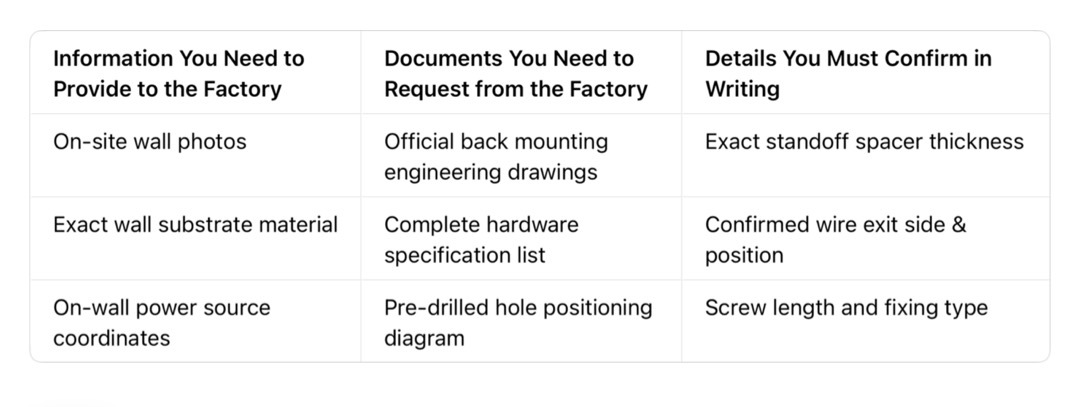
Complete Pre-Production Mounting Checklist (Save for Every Project)
Use this table to eliminate 100% of avoidable on-site mounting failures before production starts.
Why Sample Consistency Matters for Structural Mounting Standards
Many buyers only verify visual and lighting effects during sample confirmation, ignoring back structure and mounting hardware standards.
Bulk production may adjust backplate thickness, standoff specifications, or hole layouts without notification, leading to perfect-looking samples but structurally mismatched bulk goods that fail installation.
sample-to-bulk structural mismatches
Final Takeaway
Perfect-looking signs can still fail completely on-site.
The most costly sign project delays do not come from bad paint, dim LEDs, or wrong dimensions. They come from missing wall substrate confirmation, absent engineering drawings, generic hardware, misaligned wire exits, and blind hole positioning.
Reliable overseas sign manufacturers do not only produce aesthetically correct signs. They proactively verify your on-site wall conditions, power layout, and mounting requirements before cutting any material.
If you are preparing a custom channel letter project and want to eliminate all on-site mounting risks before production, contact our team for full pre-production structural and mounting consultation.
Turn brand vision into benchmark-grade signage.
See more real project examples on Instagram and LinkedIn — search @MengbanSign.