
Refurbish Old Storefront Signs vs Replace with New Channel Letters: Which Saves You More?
Posted by Mengban Team on Oct 2nd 2026
When your storefront LED signs grow dim, develop dark spots, leak water, or suffer faded finishes, every business owner faces the same critical question: should you refurbish the old signage or replace it with brand-new custom channel letters?
Most people only compare upfront costs and make hasty decisions. However, signage projects involve hidden maintenance fees, lifespan limits, building compliance rules, and wall repair risks. Choosing the wrong solution often leads to repeated failures, unexpected expenses, and interrupted storefront branding.
To help you make a cost-effective, long-term decision for your commercial property, we break down the true differences between sign refurbishment and full sign replacement, including overlooked hidden costs, applicable scenarios, and professional recommendations.
When to Refurbish Your Old Storefront Sign
Sign refurbishment is ideal for short-term business plans and structurally sound existing signage. Refurbishment includes replacing failed LED modules, swapping faulty transformers, repairing loose wiring, repainting faded surfaces, and fixing minor water leakage issues.
Best Scenarios for Sign Refurbishment
- The original metal frame, acrylic face, and mounting structure remain solid and undamaged
- Only electrical components (lights, power supply) are failing
- You plan to occupy the storefront for only 1–3 more years
- Your existing sign already meets local city codes, HOA rules, and landlord requirements
- You have a limited budget and want a quick, low-cost fix
Key Advantages of Refurbishment
Refurbishment saves significant upfront investment, requires minimal construction time, and avoids complicated procedures such as old sign removal, wall restoration, and permit reapplications. For temporary business occupancy, it is the most economical solution.
Hidden Downsides of Refurbishment
Refurbished signs come with obvious limitations. Older sign models often use discontinued LED accessories, making future repairs harder and more expensive. Refurbished lighting performance cannot reach the brightness and uniformity of modern channel letters, and no formal manufacturer warranty covers modified old signage.
When to Replace with Brand-New Custom Channel Letters
Full sign replacement is a long-term investment designed for stable, long-term store operation. It completely resolves aging structure risks, outdated designs, and non-compliant code issues that refurbishment cannot fix.
Best Scenarios for Full Sign Replacement
- The original sign frame is rusted, deformed, cracked, or severely water-damaged
- The sign has served more than 7 years and requires frequent repeated repairs
- You are rebranding your business with a new logo, font, or color scheme
- The old sign fails to meet updated local commercial signage codes
- You plan long-term store operation and want stable, low-maintenance branding
Key Advantages of New Channel Letters
Hidden Downsides of Full Replacement
New sign installation requires professional old sign dismantling, wall surface repair, and sometimes new permit applications. The upfront material and labor cost is higher, and the overall project timeline is longer than simple refurbishment.
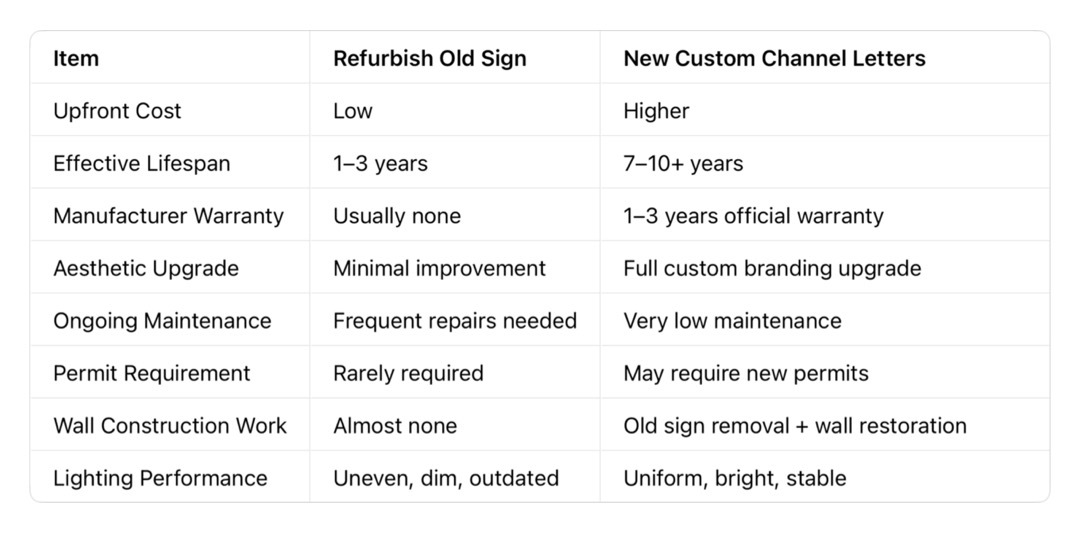
Side-by-Side Comparison: Refurbish vs Replace
This clear comparison helps you quickly evaluate which solution fits your project:
Overlooked Hidden Costs That Determine Your Final Budget
Hidden Costs of Sign Refurbishment
- Discontinued spare parts: Old sign LED strips and transformers are often phased out, forcing expensive custom replacement parts.
- Repeated service calls: Aging structures continue leaking and shorting, leading to continuous repair fees.
- Inconsistent branding: Dim or uneven lighting weakens storefront attractiveness and customer trust long-term.
Hidden Costs of Sign Replacement
- Professional removal fees: Improper DIY removal causes wall cracking, paint peeling, and electrical damage.
- Facade restoration cost: Bolt holes, adhesive residue, and wall ghosting require professional repair before installation.
- Project delay risks: Unplanned wall issues or permit delays extend your storefront upgrade timeline.
If you plan a full sign replacement, safe and standardized dismantling is the first step to avoid extra losses. Learn professional procedures in our guide: Removing Old Storefront Signs: Risks & Best Practices Before New Channel Letters.
How to Choose: Quick 3-Check Decision Checklist
- Is the original sign structure still intact and rust-free? If not, replacement is mandatory — refurbishment cannot fix structural aging.
- How long will you operate at this location? Short-term occupancy = refurbish; Long-term business investment = replace.
- Does the old sign meet current local signage regulations? Non-compliant old signs must be replaced to avoid fines.
Post-Project Quality Control Matters
After installation, systematic on-site inspection ensures stable mounting, perfect alignment, and flawless lighting output. Follow our professional post-install checklist: How to Inspect Channel Letters After Installation.
Final Verdict: Which Option Is More Worth It?
- Choose refurbishment for short-term store use, intact structures, and tight budgets. It solves immediate problems with minimal spending.
- Choose new custom channel letters for long-term branding, rebranding updates, non-compliant old signage, and aging structures. The official warranty and ultra-low maintenance save substantial money in the long run.
Explore Our Custom Channel Letter Projects
If you are ready to upgrade your storefront with durable, high-quality custom channel letters for long-term business growth, browse Our Projects to view real completed commercial signage cases, diverse storefront styles, and professional installation results.
If you are preparing a custom channel letter project and want to eliminate all on-site mounting risks before production, contact our team for full pre-production structural and mounting consultation.
See more real project examples on Instagram and LinkedIn — search @MengbanSign.